Fokine's Figures
This text was created by esteemed choreographer Michel Fokine in order to preserve the nontraditional poses of his original ballet Le Dieu Bleu. Fokine choreographed Le Dieu Bleu for the Paris-based Russian ballet company, Ballet Russes, premiering the work on May 13, 1912. Ballet Russes was internationally recognized for its groundbreaking choreography and avant-garde interpretation of classical ballet. The company was largely comprised of Russian dancers and artists fleeing the conservatism of the Russian art scene for the freedom of expression that Paris allowed. Fokine similarly found his creativity to be stifled as a young dancer in Saint Petersberg’s Imperial Ballet Academy, and he transitioned to choreographing pieces abroad in order to find a more receptive audience for his reinterpretation of ballet. Fokine’s term as choreographer-in-residence for Ballet Russes marked a period of great experimentation for Fokine and the company, catalyzing a Parisian renaissance of ballet. In this text one can see Fokine’s attempts to move past the classical definition of ballet in Le Dieu Bleu. Whereas every step in the ballet canon corresponds to a specifically defined French term, Fokine’s unusual poses must be represented by drawn human silhouettes. Each silhouette in the text corresponds to a number, and each pose would have been taught to the dancers as corresponding to this numbered count in the music. Thus, this text can be directly translated into a phrase of movement. The translation of movement into text was made by Fokine in order to preserve his choreography for future stagings of La Dieu Bleu. This transition from dance described in French terminology to figures can be equated to a transition from a modern alphabetic system to a more ancient logographic system, in which a figure corresponds to a certain pose. In Fokine’s transition from classical choreography, which comes complete with its own language, to modern choreography, one can see the attempt to recreate a language of movement from the very beginning.
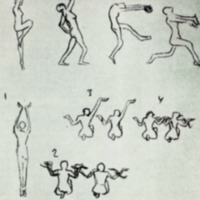
Annotations on Fokine's Figures
- The numbers Fokine has written above each figure corresponds to the count of the music that the step should be performed upon. Dancers traditionally count music in sets of eight counts; thus, in creating phrases of 4 and 6 counts apiece, Fokine’s choreography can naturally be performed multiple times in succession while remaining in time with the music. Of additional note is that the dancers in Le Dieu Bleu were performing alongside a live orchestra, with whom the dancers would have closely collaborated. Instead of the dancers merely following the counts, the movements of the piece would have been familiar to the conductor of the pit orchestra, who would be responsible for helping pace the orchestra in time with the dancers.
- In this first four count phrase, it is important to note the extreme detail in the movement that Fokine is notating. The movement of the figure from the left to the right of the page corresponds to the horizontal movement across the stage that the dancer would follow. In this way, Fokine’s two dimensional figures can be mapped to a three-dimensional movement upon the stage.
- For a relatively simple phrase consisting of four steps, there is remarkable detail in the dancer’s upper body, details that break beyond the traditional ballet curriculum. The free movement of the back, contrasted with the sharp angles of the arms and wrists, is not seen in more traditional ballets. Thus, unlike the traditional shapes of the arms in ballet, these poses lack a formal name.
- The second phrase of movement, consisting of six figures, is to be performed in a line of multiple dancers. Following the figures from number one through six, the dancers begin with their backs to the audience. Beginning in figure 2, there are now two figures shown performing the same movements. This suggests that the phrase was performed in unison by a line of dancers, most likely the corps de ballet of the Ballet Russes. The symmetry of the pair’s movement implies that this could be performed not just by a couple, but by a long line of dancers replicating this movement. The corps de ballet performing simple yet beautiful movements in a long line, typically towards the back or sides of the stage while a soloist performs, is a popular motif in many traditional ballets. However, these poses detailed by Fokine are not known in the traditional ballet repertoire. Thus, Fokine is working within a typical motif of the corps de ballet to create a new style of dance.