Understanding Wagner
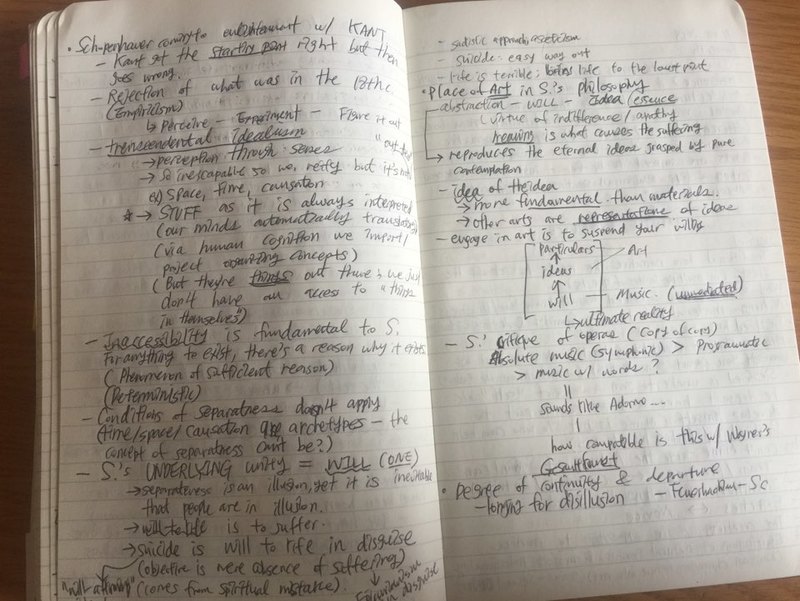
Transcription:
Kant's influence on Schopenhauer
- (According to Schopenhauer) Kant got the starting point right but then gets it wrong.
- Rejection of what was happening in the 18th century (Empiricism)
Transcendental Idealism
- perception through senses
- (things that are) so inescapable so we reify them, but they are not things "out there." Examples are space, time, and causation.
- stuff is always interpreted (our minds automatically translate via human cognition. We import/project. Organizing concepts. There are "things" "out there" that we don't have an access to: things-in-themselves.)
Inaccessibility is fundamental to Schopenhauer. For anything to exist, there's a reason that it exists. Phenomeon of sufficient reason; Determinism
Conditions of separateness doesn't apply to time/space/causation because they are archetypes (?)
Schopenhauer's UNDERLYING UNITY = WILL (One)
- Separateness is an illusion, yet it is inevitable that people fall into illusion.
- Will to life is to suffer.
- Suicide is will to life in disguise. (Objective of suicide is mere absence of suffering; it's a "will-affirming" action. Schopenhauer views suicide as an easy way out; sadistic aescetic approach)
Place of art in Schopenhauer's philosophy
- Abstraction - Will - Idea (essence)
- Virtue of indifference/apathy
- meaning is what causes the suffering
- Reproduction of the eteral ideas grasped by pure contemplation
- idea of idea = more fundamental than materials
- Engaging in Art is to suspend your will
Particulars [Art]
Ideas [Art]
Will = Ultimate reality [Music]
- Schopenhauer's critique of opera as a copy of copy
- Absolute music > programmatic music with words
- Sounds like Adorno..
- How compativle is this with Wagner's Gesamltkunst?
- Absolute music > programmatic music with words