Reply to the Comments
Answer to Steph's Question
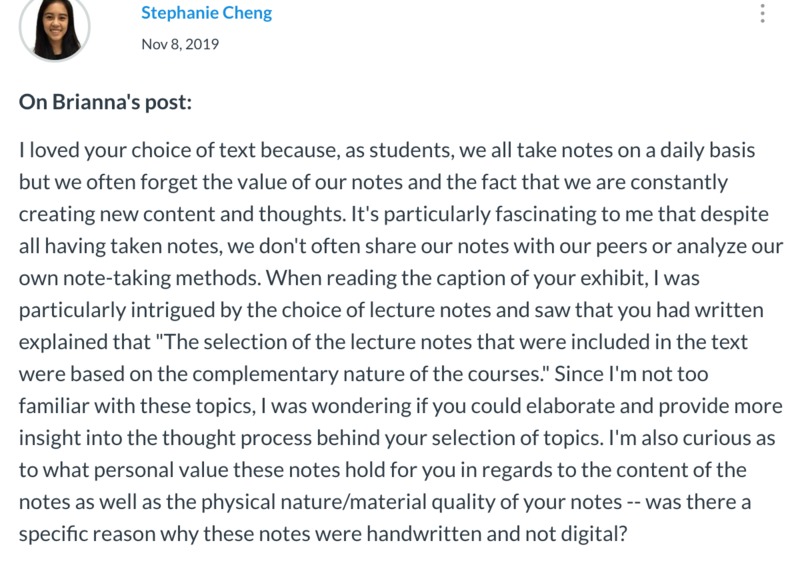
Steph's question helped me realize that I should have more clearly justified my choice of courses to include in this exhibit. To paraphrase Steph's question, "what was the process behind choosing these topics?"
The straightforward answer to this question is that these were some of the most enjoyable courses that I've taken at Harvard. I thought that these courses truly embodied the ideals of interdisciplinary studies and I gained so much by taking these courses.
The deeper answer would be this: The common denomedator between the three courses that I chose to include in this project is that they exceed or break your expectation about the course. You go to a class called "Understanding Beethoven," expecting that it would be about music history and music theory, and come out of the class having an amazingly informative introduction to Hegelian dialectic and Adorno's aesthetic theory. "Understanding Wagner" was similar––although the class was mainly about reading and listening to Wagner's Ring Cycle, I learned about Kant, Marx, and Hegel. "Adorno's Aesthetic Theory" sounds like it's just about his aesthetic theory, but you learn so much about Adorno's general philosophy.
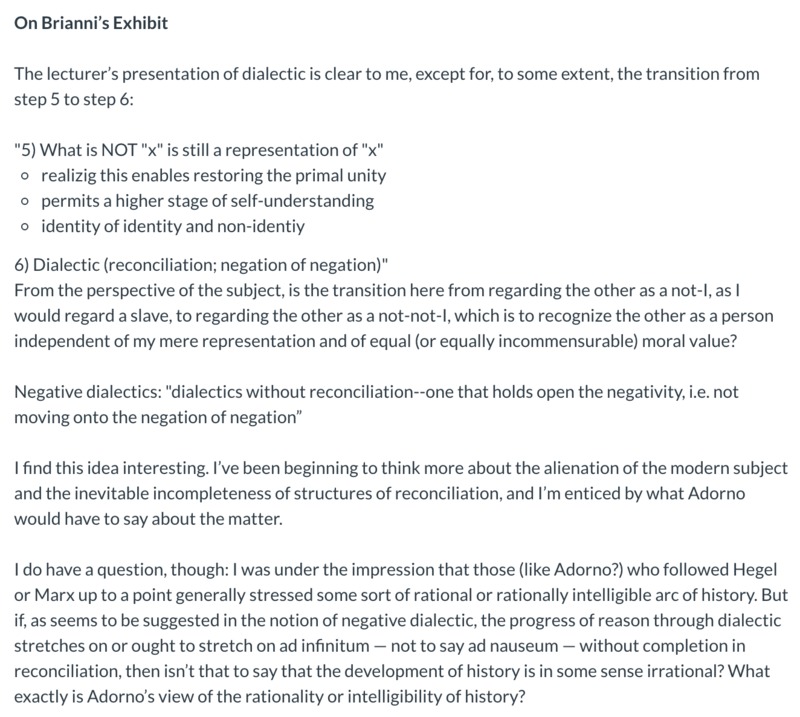
Answer to Bin's Question
Bin raised a really helpful question about Adorno's negative dialectics. To paraphrase his question, "what does Adorno think about the rationality and the intelligibility of history when he does not accept the final reconciliation?"
To give a short answer, even though Adorno stems from Hegelian and Marxist traditions, Adorno's core ideas differ greatly from those of Hegel and Marx. For Adorno, making history intelligible is not at all the goal of philosophy, as it is for Hegel. Although Adorno thinks that history has an arc to it, it does not make history rational. Adorno and Horkheimer's book "Dialectic of Enlightenment" tell the story of how Enlightenment––the movement towards rationality––in fact began deeply irrational course of development in modernity that made human beings less free.
According to Adorno, since the Enlightenment, the type of rationality that governs modernity has been instrumental reason, and instrumental reason violently subsumes and oppresses the particulars. It also turns all social relations into ones of dominating-dominated relations.
Adorno has an alternative mode of rationality to instrumental reason: mimesis. Mimesis should be understood not as representation but as embodiment or mirroring. Adorno's "Aesthetic Theory" is a place of glimmering hope in otherwise deeply pessimistic philosophical body, as artwork becomes the site of mimesis.